The Trapped Profits Reform: What Every Controlling Shareholder of a Closely Held Company Needs to Know (2026)
A guide to the reform’s two new tax tracks and their practical implications for controlling shareholders of closely held companies.
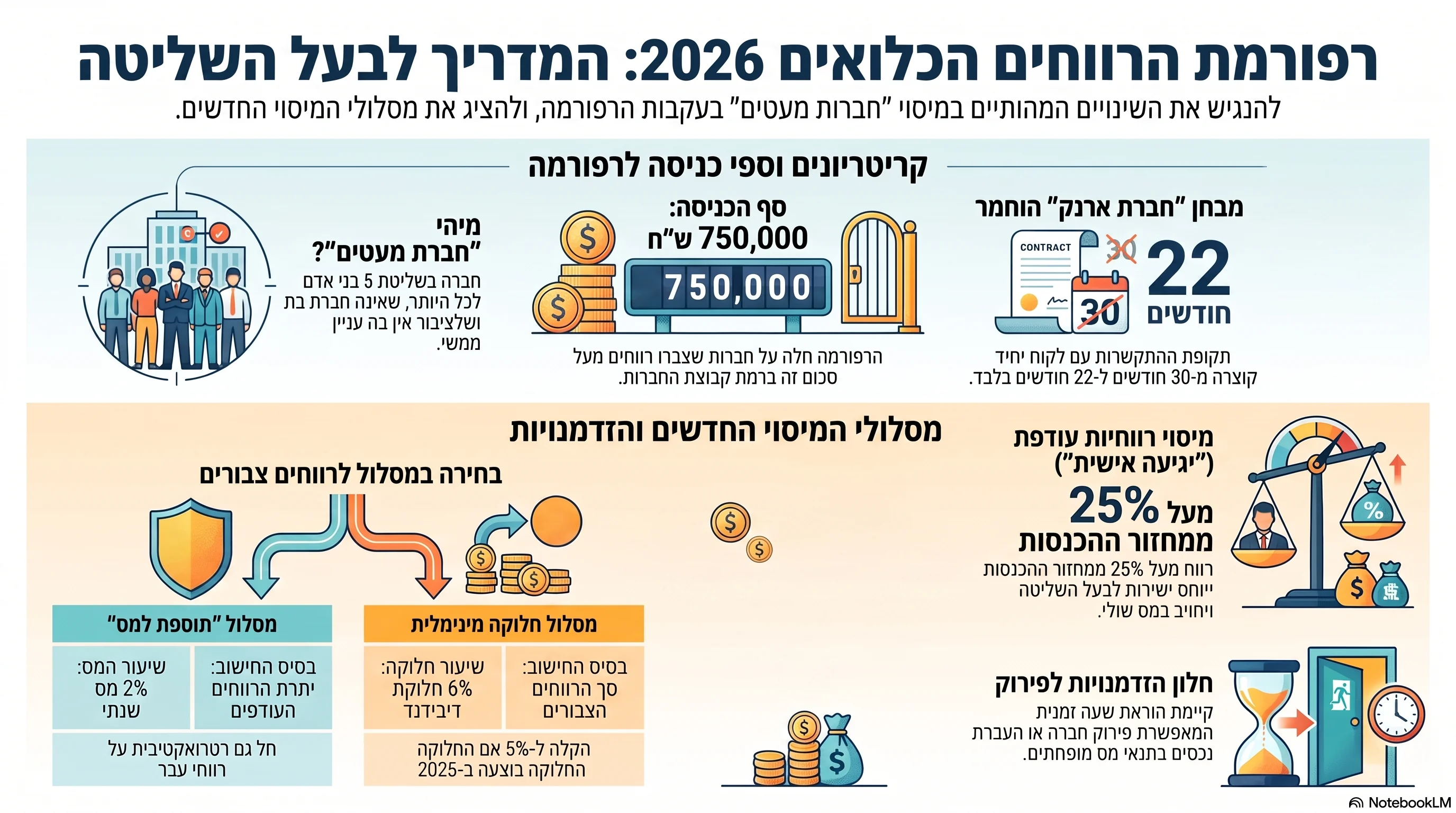
At the end of 2024, the Knesset approved a fundamental change to the taxation of closely held companies in Israel—a measure known as the “trapped profits reform.” The reform has applied since the 2025 tax year and is fully reflected in 2026 reporting and tax planning. It changes the rules for controlling shareholders who accumulated profits in a company without distributing them as dividends. This article explains the reform’s background, its two main tax tracks, and the practical consequences for business owners.
The background for the reform
On December 31, 2024, the Knesset approved Amendment 277 to the Income Tax Ordinance, within the framework of the Economic Efficiency Law (Legislative Amendments to Achieve Budget Goals for 2025), 2024. The purpose of the amendment is to reduce a phenomenon in which controlling shareholders leave large profits “locked up” within the company, instead of distributing them as dividends and paying shareholder tax on them, with the desire to postpone the payment of the tax and sometimes also benefit from other tax benefits. The reform includes two main mechanisms: taxation of current profits (expansion of section 62A - “wallet companies”) and taxation of undistributed profits (new sections 81A-81F).
What is a “closely held company”? The definition behind the reform
All the reform’s provisions apply to a company that meets the definition of a “closely held company” under Section 76 of the Ordinance. Income Tax Circular 01/2026, published by the Tax Authority in January 2026, established a uniform framework containing three cumulative conditions:
- The test of control - the company is under the control of five people at the most (“core of control”), when the control is tested in relation to the share capital, the voting power or the right to profits - directly or indirectly.
- The company is not a subsidiary of another company in accordance with the provisions of the section.
- The public has no material interest in the company—according to the tests clarified in the circular. For example, a holding of more than 20% by a reporting public company prevents classification as a closely held company.
Meeting the definition on even one day during the tax year is enough for the company to be classified as closely held for that entire year. This strict rule should be considered whenever the ownership structure changes during the year.
First track: taxation of current profits - expansion of section 62A (“wallet companies”)
Section 62a of the Ordinance deals with the taxation of a substantial shareholder (now a “controlling shareholder”) in a closely held company, when the company’s income actually derives from the personal activities of that controlling shareholder. The reform significantly expanded the applicability of the section:
- Officers providing management services - the exception according to which an office holder who has a certain percentage of control is not included in the provision has been made worse: the threshold has increased from 10% to at least 25% holding.
- Service providers - The old holding established that if 70% of the company’s turnover originates from a single customer in a period of 30 months out of 4 years, it is a “wallet company”. The period has now been shortened to 22 months out of 3 years – so that more companies will more easily enter the definition.
- New subsections (62A(A1)-(A3)) - Regarding a closely held company whose “high personal income” exceeds a profitability rate of 25% of the turnover: the portion up to 25% profitability will continue to be subject to corporate tax at the company level, while the excess profitability beyond 25% will be attributed directly to the active shareholder, and will be charged marginal tax (instead of corporate tax).
Significant exception: This provision will not apply to a small company if the amount of accumulated profits at the level of the group of companies held by the same controlling shareholder does not exceed 750,000 NIS. Also, the provision does not apply if the annual turnover from personal income tax activity exceeds NIS 30 million (multiplied by the number of controlling shareholders).
Second track: Taxation of accumulated profits (the “locked in” profits themselves) - Sections 81a-81f
This is the most central part of the reform in terms of the impact on companies that have already accumulated large surplus balances. Sections 81a-81f of the Ordinance state that a closely held company with accumulated profits exceeding 750,000 NIS is required to choose, starting from the tax year 2025, one of two routes:
- “Tax Addition” route - payment of an annual tax addition at the rate of 2% of the amount of “surplus profits” (accumulated profits minus dividends actually distributed that year).
- Minimum distribution path - minimum dividend distribution at the rate of 6% of the accumulated profits (or only 5% if the distribution was made in 2025 itself, as an easement for the transition).
A critical point that is important to emphasize to customers: Taxation also applies retroactively to profits accumulated in the company before the law came into effect - that is, it is not only about future profits, but also a historical surplus balance that has accumulated in the company over the years.
In addition, Section 77 of the Ordinance, which gives the Director of the Tax Authority the authority to order the distribution of profits under certain conditions (forcing distribution as a dividend for tax purposes), was also updated as part of the reform and is another mechanism in the Tax Authority’s toolbox.
Temporary provision for liquidating closely held companies
Along with the strict taxation, the amendment also included a one-time temporary provision, which allows closely held companies to liquidate, or transfer assets without formal liquidation to the final shareholders, under reduced tax conditions. This is a temporary opportunity for companies and controlling shareholders who are considering reducing activity or disbanding the company anyway, and it should be examined in time, since the window of opportunity is not fixed.
Latest circular updates from the Tax Authority
The reform is accompanied by regular publication of professional clarification circulars from the Tax Authority:
- Income Tax Circular 7/2025 (October 2025) - deals with detailing sections 81a-81f and the numerical examples of their application. The circular was updated in February 2026, when, among other things, the reporting and payment dates were changed, and the issue of classifying land stock as “special property” was clarified.
- Income Tax Circular 01/2026 (January 2026)—sets a uniform definition of a closely held company for all relevant sections (62A, 64, 64A, 77 and 81A–81F), replacing earlier guidance.
Accounting implications
The Israeli Institute for Standardization in Accounting published a professional guideline (2025/1) dealing with the accounting consequences of the tax increase on undistributed profits in the financial statements of closely held companies - an issue that is particularly relevant to companies that prepare audited or reviewed financial statements, and requires coordination between the tax treatment and the accounting treatment.
Practical recommendations
- Every closely held company with significant accumulated profits should examine already whether it crosses the NIS 750,000 threshold, and if so - choose a course (2% addition versus a minimum distribution) with a full understanding of the long-term consequences.
- Controlling owners who provide management or consulting services through a company should re-examine their holding rate and revenue structure, in light of the tightening of the conditions in section 62A (the threshold increased to 25% holding, and the period shortened to 22 out of 36 months).
- Companies with high profitability from activities with a lot of personal income (over 25% of the turnover) should examine the division of income between corporate tax and marginal tax at the controlling shareholder.
- It is worthwhile to seriously examine the temporary order for the liquidation of closely held companies, especially for companies that are planning to reduce activity anyway.
- The updates of the Tax Authority’s professional circulars must be followed, as the subject is still in the process of continuous interpretive formation, as evidenced by the frequent updates since the reform came into force.
In conclusion
The reform of retained earnings is one of the most significant changes in the taxation of closely held companies in Israel in the last decade. It requires every controlling shareholder of such a company to re-examine the holding structure, the dividend distribution policy and the method of rewarding the owners - both in relation to future profits and, unusually, in relation to profits that have already been accumulated in the past. Early and professional preparation can save the company and its owners significant amounts of tax, and prevent exposure to double payment or a dispute with the tax authority.
The information in this article is general and does not constitute personal tax advice. This is a complex issue that is still in the process of being interpreted, and the provisions of the law and the circulars may be updated. It is recommended to consult individually according to the structure and data of the specific company.