Tax Benefits for Reservists in 2026: A Guide for Accountants and Clients
The new tax-credit entitlement for combat reservists, the value of the benefit, and how employees and self-employed professionals can claim it.
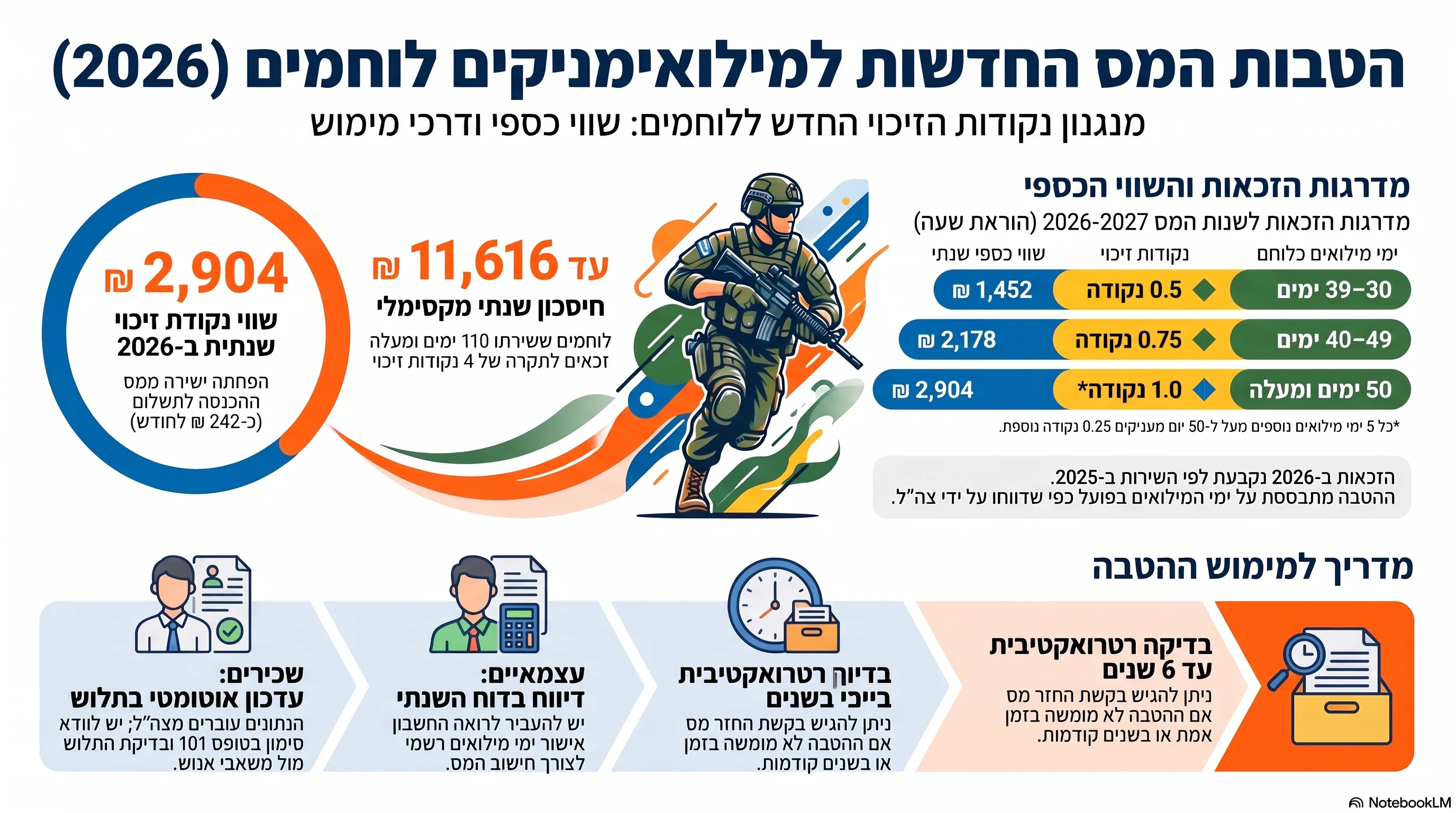
The year 2026 brings a significant change to the taxation of reservists in Israel, especially combat reservists. Following the unprecedented scale of service since the “Swords of Iron” war and the campaign against Iran, the legislature approved income-tax credit points for service as a combat reservist for the first time, in addition to existing benefits. This article explains the new benefit, who qualifies, how it is calculated, and which additional tax benefits are relevant to reservists.
The background to the legislation
On November 23, 2025, a law was published in the records to amend the Income Tax Ordinance (No. 283), 2025-2025, which grants income tax credit points for reserve service as a soldier. The benefit entered into force in January 2026, and is given according to the reserve days actually performed as a soldier in 2025 (and will affect the pay slip/annual report for the tax year 2026).
What are credit points, and what is the value in 2026
A credit point is a mechanism that directly reduces the amount of income tax that a person owes. The credit point is not a grant that is transferred directly to the bank account, but rather reduces the actual tax liability - for an employee through the pay slip, and for the self-employed through the annual report.
As of tax year 2026, the value of an annual credit point is 2,904 NIS (about 242 NIS per month). It is important to remember that credit points reduce the tax to a maximum of zero - those who are not subject to income tax anyway (for example due to low income) will not actually benefit from the additional financial benefit.
Levels of eligibility for the 2026-2027 tax years
The law established special, and relatively lenient, eligibility levels for the first two tax years to be implemented - 2026 and 2027 (referring to reserve service as a soldier in 2025-2026):
| Days of reserve service as a combatant | Credit points | Annual value |
|---|---|---|
| 30–39 days | 0.5 point | NIS 1,452 |
| 40–49 days | 0.75 point | 2,178 NIS |
| 50 days or more | One point | 2,904 NIS |
| Every additional 5 days beyond 50 | 0.25 extra point | 726 additional NIS |
The maximum ceiling is 4 credit points (for 110 days of service as a soldier or more), the cumulative annual value of which is 11,616 NIS.
This is a temporary provision with more lenient thresholds, designed to address the unusually high volume of reserve service during these years. Starting in 2028, the legislation is expected to move to the permanent framework. The entry threshold for the first tier should fall to 20–24 days of service, making more reservists eligible but under graduated credit rates different from the temporary tiers above.
Who is entitled to the benefit?
The benefit is intended for people defined as combatants in the reserve service under the criteria set by regulation, generally those serving in combat units with the relevant qualification. According to Treasury data presented during the legislative hearings, about 78% of the combat reserve force is expected to qualify for the first tier based on service in 2025.
The benefit applies to both employees and the self-employed.
How to realize the benefit in practice
Employees: The process is expected to be largely automatic - the IDF transmits the reserve days data directly to the Tax Authority, and the benefit should be updated on the pay slip. However, it is recommended to verify in practice that the benefit does appear on the slip, and contact human resources or the reserve hotline (1111, extension 4) in the event of a discrepancy. An employee is required to report this to the employer on Form 101 (Part VIII, Section 16), together with a certificate from the IDF attesting to the days of service as a soldier. An employee employed by more than one employer should do this through the online tax coordination system.
Self-employed: The self-employed must submit to his accountant the IDF certificate with the exact number of reserve days as a soldier, so that the benefit is included in the tax calculation as part of the annual report.
If the benefit is not realized in real time: You can apply for a retroactive tax refund up to 6 years back, by submitting online or contacting the assessor’s office. This is mainly relevant for those whose income was irregular during the year (for example, recruitment in the middle of a tax year), for those who worked for several employers, or for those whose employer simply did not update the benefit on the slip.
Additional tax benefits worth knowing
In addition to the new credit points for fighters, there are old tax benefits that are relevant to reservists in general:
- General credit points for reservists - a long-standing mechanism that also exists for those who are not defined as “combatants”, according to the number of days of service, and accumulates in addition to the 2.25 basic credit points that all Israeli residents receive.
- Reliefs within the framework of emergency orders (Order 8 / Iron Swords / The campaign against Iran) - In cases of recruitment by emergency order, the benefits may apply in an accelerated manner relative to “regular” reserve service.
- Benefits for reservists’ spouses—during 2024–2026, tax benefits were also granted to spouses of reservists who served for extended periods, recognizing the financial burden on their households.
Practical recommendations for the accountant and clients
- Verify that every client who served as a combat reservist received an IDF certificate documenting the number of days.
- Check 2026 pay slips to confirm that the benefit is actually reflected rather than assuming the employer made the update.
- For the self-employed - make sure already at the stage of preparing the annual report that the data of days of service are included in the calculation.
- Examine for old customers the possibility of submitting retroactive tax refund requests up to 6 years back, especially for those who served in the reserves in 2020-2025 and did not exercise tax benefits at the time.
- Follow the publication of the regulations detailing the exact criteria for defining “combatant” for the purpose of the benefit, as these may affect the eligibility of specific customers.
In conclusion
The new tax benefit for military reservists constitutes a significant change in the taxation policy in Israel, and allows for savings of up to NIS 11,616 per year for those who performed long service. This is a benefit that requires proactive testing - both to ensure correct implementation in real time, and to examine eligibility for retroactive refunds. Professional accompaniment by an accountant can save the clients they serve a lot of money that sometimes remains “in the state treasury” without being exhausted.
The information in this article is general and does not constitute personal tax advice. The rules, steps and regulations may change, and it is recommended to check specific eligibility with the tax authority and in individual consultation.