The Law for the Reduction of Cash Use: What Every Business and Individual Needs to Know (Updated for 2026)
Updated cash transaction limits, restrictions on checks and negotiable instruments, and penalties for violating the law.
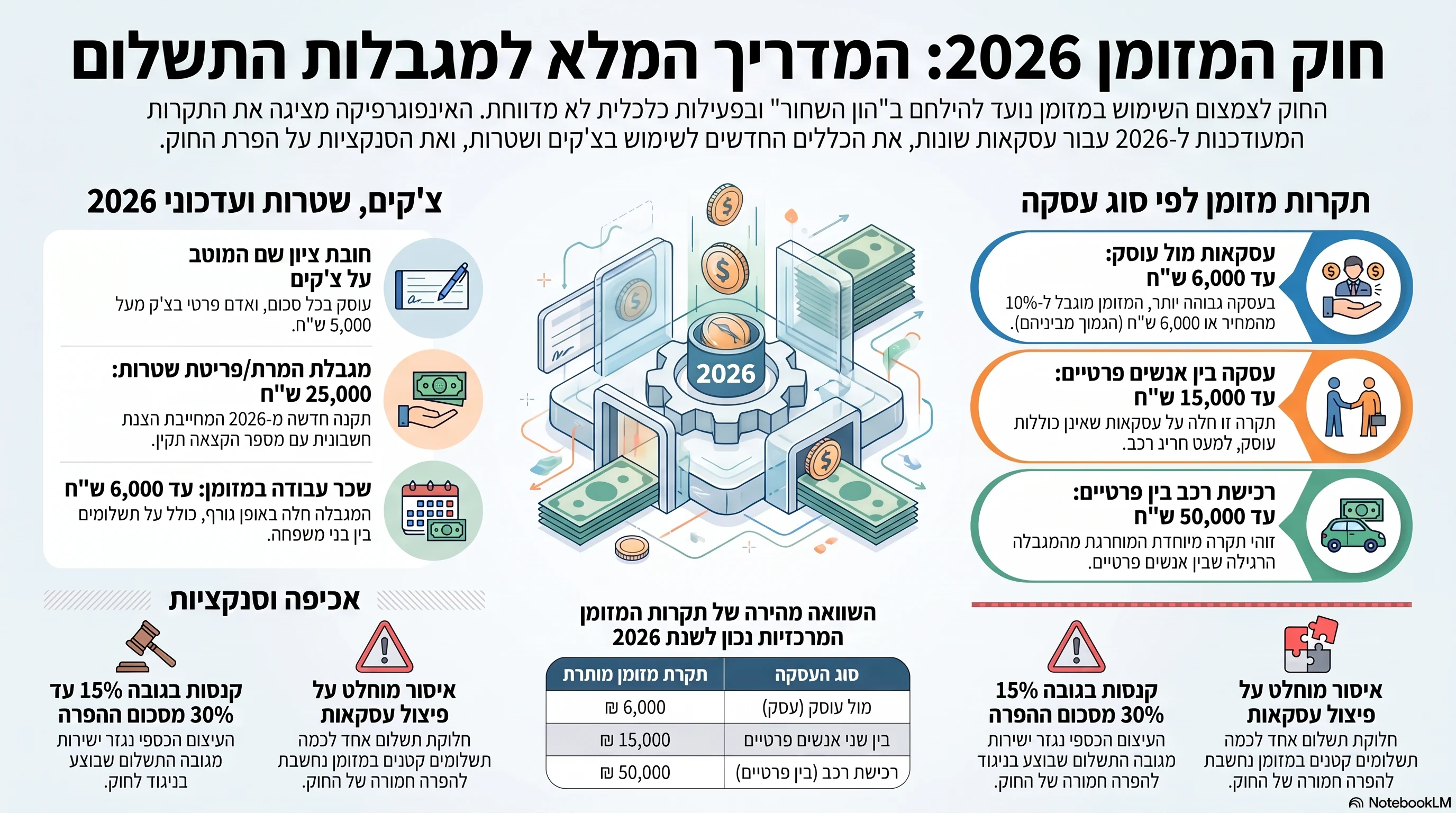
The Law for the Reduction of Cash Use, 5778–2018, entered into force at the beginning of 2019 and has since become an integral part of day-to-day business management and many private transactions in Israel. Many businesses and individuals still rely on outdated limits and are therefore exposed to significant financial penalties. This article reviews the law’s purpose, current limits, restrictions on checks and negotiable instruments, and the consequences of a violation.
The purpose of the law
The law was enacted to reduce the use of cash as a means of enabling “black capital” - economic activity that is not recorded and not reported to the authorities. Cash, due to its relative anonymity, is a convenient tool for committing tax offenses, money laundering, financing criminal activity and even financing terrorism. By limiting the amounts that can be paid or received in cash, the legislator aims to reduce the “shadow economy” and require financial monitoring of transactions of significant amounts through traceable means of payment - bank transfer, credit card or check.
Main limits as of 2026
Transaction between a dealer and a consumer (or between two dealers): It is allowed to pay in cash up to NIS 6,000. In a transaction with a higher price, you can pay in cash only up to 10% of the transaction price, and in any case no more than NIS 6,000 - and the balance must be by another means of payment (bank transfer, credit card or check).
Transaction between two private individuals (who are not engaged in business): It is allowed to pay in cash up to NIS 15,000.
Exception for a car: When purchasing a vehicle between two private individuals, the ceiling remains NIS 50,000 in cash.
Payments of wages: Payment or receipt of wages in cash is subject to the same ceiling of NIS 6,000 - and the rule applies even between family members, unlike other payments between relatives, which are generally exempt from the restrictions of the law.
Donations and loans: Receiving a donation or giving/receiving a cash loan is also subject to the limitations of the law, similar to normal transactions.
It is important to remember: the test refers to the entire amount of the transaction, and it is not possible to “split” a payment between several small cash payments in order to bypass the ceiling - such splitting may be considered a violation of the law in itself.
Restrictions on checks
The law is not satisfied with restrictions on cash, but also applies to the use of checks:
- A business must state the payee’s name on every check it issues or receives, regardless of the amount.
- Individual must indicate the name of the recipient on a check for an amount exceeding NIS 5,000.
- Endorsing a check to another person requires the endorser’s name and identity number.
2026 amendments: negotiable instruments and discounting
In 2026, the Knesset’s Constitution Committee approved, within the framework of the Economic Efficiency Law, additional amendments to the law dealing with dealing with banknotes:
- Discounting an instrument for cash—limited to NIS 6,000.
- Promissory note denominated in foreign currency - can be redeemed (cashed) in cash up to NIS 25,000.
- Conversion or withdrawal of a bill for cash - limited to NIS 25,000, provided that the dealer presents an invoice with a proper allocation number and a receipt.
- Repayment of a loan given in cash - excluded from the limit up to a ceiling of NIS 25,000 per note.
These amendments are designed to close loopholes discovered in the use of banknotes as a way to circumvent the usual cash limits, and sharpen the importance of orderly documentation (including an allocation number) in any operation of this type.
What happens in the event of a violation
The violation of the law exposes the violator to an administrative financial sanction, the amount of which is derived from the amount of the violation - at a rate of between 15% and 30% of the amount of the payment made or illegally received in cash. To the extent that the sanction is imposed on a dealer, the violation may also constitute a negative indication in the context of future tax audits.
It should be noted that regarding the payment of wages in cash, a temporary relief was established in the past, according to which a sanction will not be imposed for the first violation of this type, but only after giving an explicit warning in advance. However, this is a time-limited relief, so you should not rely on it as a default - you must check its current status with the tax authority.
Practical recommendations
- Make sure that the collection and payment systems in the business (cash register, bookkeeping) “know” the current ceilings and alert when a transaction approaches the prohibited cash threshold.
- Avoid any attempt to split a cash payment into several small payments to bypass the ceiling - this is a violation for all intents and purposes.
- State the check payee’s name and, when endorsing a check, the endorser’s identity number as required.
- In transactions that include discounting, redemption or conversion of bills - make sure to present an invoice with a proper allocation number, in accordance with the 2026 amendments.
- When there is doubt about the permitted means of payment in a particular transaction, it is recommended to use the dedicated simulator established by the Tax Authority to check the restrictions, and to consult with an accountant before carrying out transactions of large amounts.
In conclusion
The law to reduce the use of cash continues to be tightened - both through expanding the restrictions on bills and discounting, and through increased enforcement. Businesses and individuals alike are required to be familiar with the current ceilings and adjust their payment methods accordingly, in order to avoid financial sanctions and unnecessary exposure to the tax authorities.
The information in this article is general and does not constitute personal tax advice. The rules and ceilings may change from time to time, and it is recommended to consult individually according to the data of the specific transaction.