Allocation Numbers under “Israel Invoices”: What Every Business Needs to Know (Updated for 2026)
A guide to mandatory thresholds, obtaining allocation numbers, and the model’s effect on input VAT deductions.
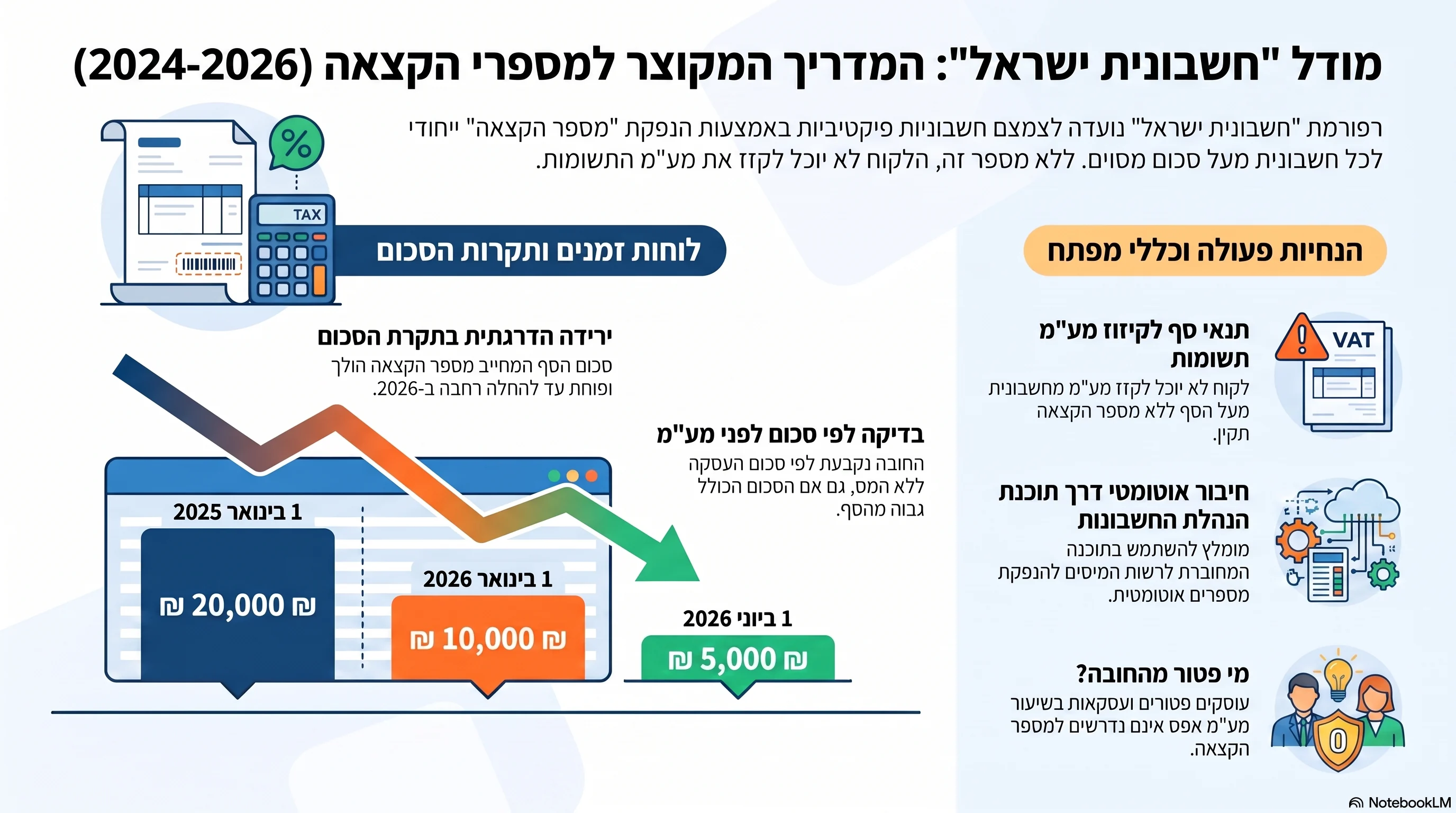
The “Israel Invoice” model changes the way businesses in Israel issue and receive tax invoices. Those who do not know the rules may find themselves - or their customers - without the possibility of deducting input VAT, even when the transaction itself is completely normal. In this article I will explain what an allocation number is, who is obligated, what happens when there is no allocation number, and how to prepare correctly.
What is an allocation number, and why is it needed?
An allocation number is a unique identification number (nine digits long) issued by the tax authority to every tax invoice that meets the threshold conditions established by law. The number is received from the tax authority near the time the invoice is issued, and must appear on the invoice itself.
The model’s main purpose is to reduce fictitious invoices—documents that do not reflect a real transaction and are used by fraudulent businesses to reduce their VAT liability artificially or even obtain unlawful VAT refunds. This phenomenon costs the state treasury billions of shekels each year, which is why a central database was established to let the Tax Authority verify reported transactions in real time.
The legal framework for the establishment of the model is the Economic Efficiency Law (amendments to legislation to achieve the budget goals for the 2023 and 2024 budget years), the 2023-2023 Act, according to which the model will gradually come into effect starting in May 2024.
How does this affect input VAT deductions?
The critical point that every business owner must internalize: the allocation number is a precondition for input tax deduction at the recipient of the invoice. In other words - if an invoice above the threshold amount does not carry a proper allocation number, the customer who received it will not be able to deduct the VAT he paid, even if the transaction was actually carried out and if the invoice is correct in every other respect.
The practical meaning is that a supplier who does not take care to produce an allocation number may discover that customers refuse to pay the full amount of the invoice, or demand a correction before payment - especially when it comes to large business customers or public bodies that are strict about the issue.
Thresholds: what changed and when
The ceiling of the amount above which an allocation number is required is gradually decreasing since the launch of the model:
| Effective date | Threshold before VAT |
|---|---|
| May 2024 | 25,000 NIS |
| January 1, 2025 | 20,000 NIS |
| January 1, 2026 | 10,000 NIS |
| June 1, 2026 | 5,000 NIS |
It is important to note two points:
- The check is carried out according to transaction amount before VAT - an invoice for an amount lower than the threshold before VAT is not charged with an allocation number, even if after adding VAT the total amount exceeds the threshold.
- As long as it is a transaction with a high amount that is not subject to VAT (for example, a service to a foreign resident customer at a zero VAT rate), an allocation number is not required and will not be given at all.
The trend of the reform indicates that in the coming years the threshold may continue to decrease, so that the scope of transactions subject to an allocation number will only expand.
Who is subject to the obligation, and who is exempt
The obligation applies to authorized dealers, limited liability companies and partnerships, in every production of a tax invoice or tax-receipt invoice to another authorized dealer - above the threshold amount.
Those not required to obtain an allocation number include:
- Exempt businesses.
- Transactions that are not subject to VAT, such as transactions with a zero VAT rate.
- Documents that are not a tax invoice - such as a credit invoice, self-invoice or proforma documents, are not required to have an allocation number as an independent step (although in a proforma transaction for which a tax invoice has not yet been produced, you can request an “allocation confirmation number” to be printed on the transaction account).
Separately from this, it should be noted that even non-profit organizations that hold approval according to section 46 are currently obliged to report each donation and receive a corresponding reporting number for it - regardless of the amount of the donation.
How to obtain an allocation number
There are two main courses of action:
1. Using connected accounting software - most modern accounting software is today connected to the Tax Authority’s system. In such a case, as soon as an invoice above the threshold amount is generated, the software automatically sends the transaction details (the customer’s authorized dealer number, amount before VAT, the VAT amount and the invoice details) to the Tax Authority’s servers, and receives back the allocation number printed on the invoice - without the need for manual action.
2. Submitting a manual application—businesses using a manual invoice book or software that is not connected to the system must enter the personal area of the Tax Authority’s website and request an allocation number for each relevant invoice when it is issued.
A company (corporation) that wishes to authorize a representative - such as an accountant - to submit requests for allocation numbers for it, is required to set up an authorization for him in the personal area of the controlling owner on the Tax Authority’s website, and to renew the authorization every year. An authorized dealer who is an individual can grant a similar authorization to his representative.
What happens when the tax authority refuses to give an allocation number
Since 2025, the Tax Authority may refuse a request if it suspects that the invoice was issued unlawfully. The business then receives an online notice stating the reason and a hearing date. It may cancel the request, continue without an allocation number, use the reverse-charge mechanism that transfers the VAT liability to the customer, or request an online review by the Tax Authority’s control room. A refusal following the hearing may be challenged within 30 days, and a rejected objection may be appealed to the district court.
Practical recommendations for businesses
- Make sure that your accounting software is connected to the Israel invoicing system, so that the process is carried out automatically and without the risk of human error.
- Arrange authorizations for representatives, such as an accountant or bookkeeper, in advance through the personal area on the Tax Authority website, and renew them every year.
- When an invoice is received from a supplier - check that it has a proper allocation number before deducting input VAT. The correctness of the number can be verified in the dedicated system of the Tax Authority.
- Monitor future threshold changes, as the model is expected to continue expanding to lower-value transactions.
In conclusion
The Israeli invoicing model and the allocation numbers are no longer a matter that is relevant only to large businesses. With the threshold dropping to NIS 5,000 in June 2026, almost every business that issues or receives tax invoices in significant amounts is required to be familiar with the rules and apply them regularly. Proper preparation - correct connection of systems, regulation of permissions and checking of incoming invoices - can save a business headaches, fines, and loss of eligibility for VAT deduction.
The information in this article is general and does not constitute personal tax advice. The rules and ceilings may change, and it is recommended to consult individually according to the specific business data.