Deductible Business Expenses in Israel: The Complete Guide for Self-Employed Professionals and Companies (2026)
A practical guide to the main categories of business expenses, deduction rates, and the tax rules you need to know.
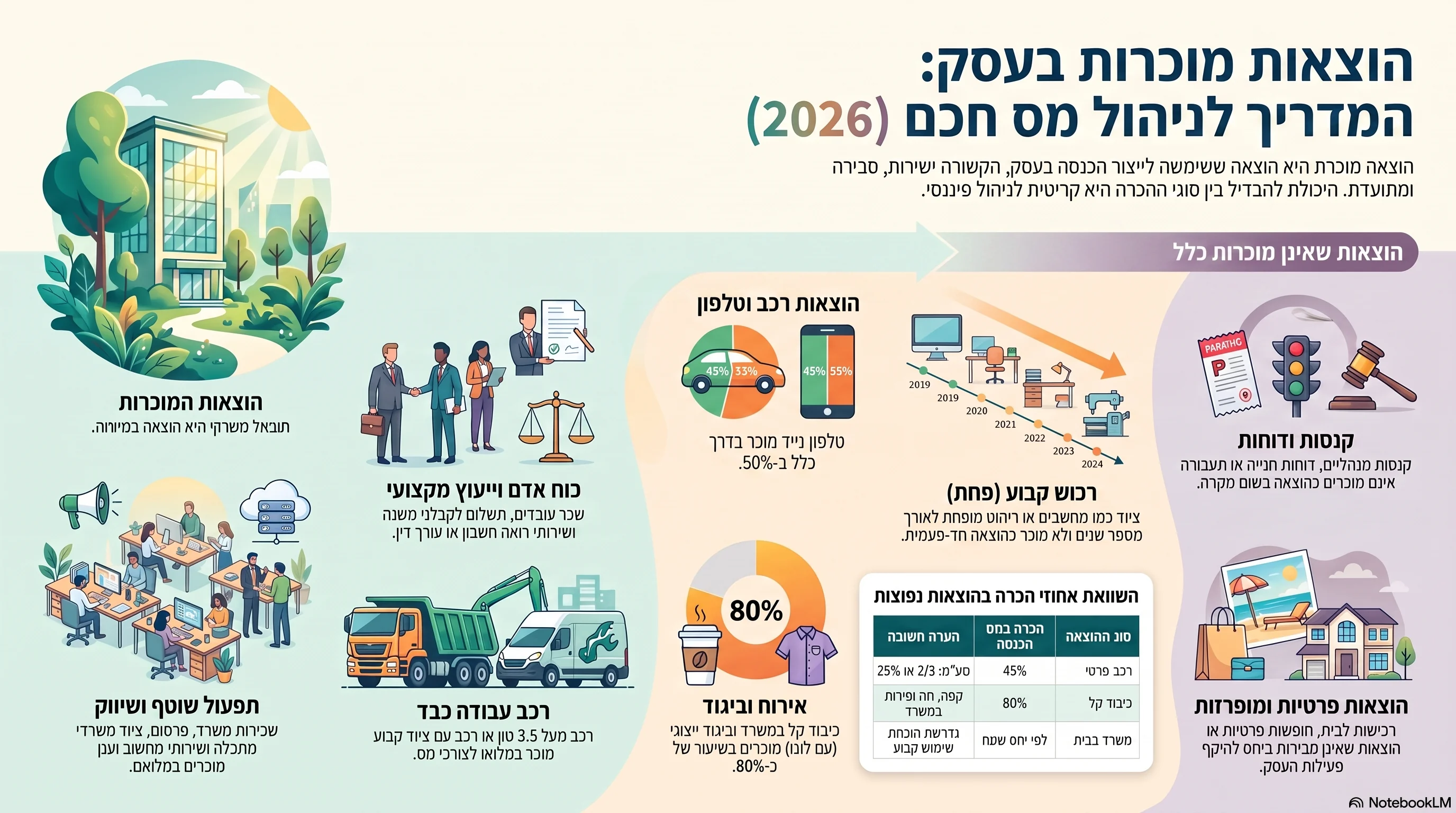
Correctly identifying deductible expenses is one of the most important ways to reduce a business’s tax burden. Not every business outlay is fully deductible for tax purposes: some are deductible in full, some only in part, and others not at all. This article explains the underlying legal principle, reviews the main categories and deduction rates, and offers practical rules of thumb.
What is a deductible expense? The legal principle
Section 17 of the Income Tax Ordinance establishes the main principle: a deductible expense is one incurred in producing income—that is, for the business and its profit-making activity rather than for private needs. In addition, the expense should be:
- directly related to the business - for example raw materials, office rent, employee wages.
- Reasonable and relevant in relation to the nature of the business and the scope of its activity.
- properly documented—with a tax invoice or receipt, depending on the type of business.
It is important to understand: the tax authority does not have a “closed list” of recognized expenses. The same expense can be recognized by one business and not recognized by another, depending on the nature of the business. For example, expenses for dog food will be recognized for a dog trainer but not for a model, and raw materials for a bakery will be recognized for a caterer but not for an electrician.
Fully deductible expenses (100%)
Expenses that are directly and clearly related to the business activity are usually recognized in full, both for income tax purposes and for VAT purposes (for a licensed dealer):
- Renting an office, shop or warehouse.
- Consumable office equipment - pens, sheets, binders, toners.
- Computer services - software, cloud storage, website maintenance, domains.
- Advertising and marketing of the business.
- Wages, business insurances, and professional consulting services (accountant, tax consultant, lawyer).
- Payment to subcontractors and external service providers (against a tax invoice).
- A heavy work vehicle (over 3.5 tons) or a vehicle that is mounted with permanent work equipment and is not intended for transporting passengers.
Mixed-use expenses: partial deduction only
“Mixed” expenses are expenses that serve both the business and the private day-to-day life of the business owner, and are therefore recognized only in a certain percentage. These are the most common expenses in this category, and the accepted percentages of recognition:
| Expense type | Income-tax deduction | Input VAT deduction |
|---|---|---|
| Private car maintenance (up to 3.5 tons) | 45% | 2/3 (mainly business use) or 25% |
| Mobile phone | About 50% | According to the applicable deduction rate |
| Light refreshments in the office (coffee, tea, fruit) | About 80% | Without VAT at source |
| Distinctive work clothing (logoed uniform, professional coat) | About 80% | Proportionate share |
| Part of a home used as an office | According to the floor-area/room ratio | According to the same ratio |
| Gifts to clients and suppliers | Up to the annual per-person ceiling (updated annually) | – |
| Overseas travel and subsistence (hospitality and lodging) | According to the regulatory ceilings | According to the regulatory ceilings |
It is important to note a few highlights:
- Car - The percentage of recognition (45%) applies to both licensed dealers and exempt dealers, and the difference between them is only in the VAT component. In a limited company, car expenses will be recognized in full only after imputation of the car’s use value on the employee’s payslip.
- A residential apartment that is also used for an office - the recognition depends on the relative part of the apartment that is actually used for the needs of the business (for example, in a 3-room apartment, one room is used for an office = about 33%). Proof will usually be required that the space is indeed used for a permanent office and not randomly, and sometimes also a withholding tax deduction from rent if it is a rented apartment.
- Restaurants and Cafes - The Tax Authority’s position is that payment for a stay in a restaurant or cafe is not considered “office services” recognized as a deduction, even if actual work was done there (e.g. a meeting with a client).
Capital expenditure and depreciation
Equipment and assets that are supposed to be used by the business over time (computers, office furniture, machines, vehicles) are not credited as a one-time expense, but are depreciated (depreciated) over several years, in accordance with the depreciation rates established in the regulations for each type of asset. For example, equipment that is depreciated over three years will be charged as a recognized expense of approximately 33.33% of its cost (without VAT) in each year out of three. On the other hand, VAT on the purchase of this type of equipment can be offset in full in the first year.
Expenses that are not deductible
There are expenses that the Tax Authority does not recognize at any rate, even if they were spent as part of the business activity:
- Fines and reports (eg parking reports).
- Donations that do not have a direct business relationship.
- “Excess” expenses - excessive or unreasonable expenses in relation to the scope of the business (for example, a luxury car “for meetings with clients” in a small business).
- Distinct private expenses, which have nothing to do with generating income in the business.
Exempt businesses, VAT-registered businesses, and limited companies
- An exempt business is not registered for VAT and therefore cannot deduct input VAT, but it may include the full amount, including VAT, as an income-tax expense.
- A VAT-registered business may deduct the VAT component in its periodic VAT returns and claim only the amount excluding VAT for income-tax purposes.
- A limited company follows the same expense-deduction principles, but some mixed-use expenses—especially vehicles—require the employee benefit to be imputed on the pay slip as a condition for full deduction.
Correct documentation - the basic condition for any recognition of the expense
In order to offset VAT, a tax invoice (or receipt-tax invoice) is required - a normal receipt is not enough, even if actually paid. A receipt from a supplier who is an exempt business is recognized as an expense for income tax purposes, but there is no VAT to offset in the first place. Proof of payment only (bank transfer, confirmation of payment in a payment application) is not a substitute for a tax invoice, and does not allow VAT offset in any case.
Practical recommendations
- Manage regular and orderly filing of all invoices and receipts according to consistent categories (office and communications, travel, marketing, equipment, financing expenses, etc.).
- Make sure to document the percentage of business use of mixed expenses (eg car or apartment) consistently from year to year.
- Check in advance with an accountant what the current recognition percentages are that apply to the specific type of business, since some of the ceilings (gifts, ESL, trips abroad) are updated from time to time in the regulations.
- Avoid presenting an expense-income ratio that is unreasonable in relation to the nature of the occupation - such a report may trigger an examination by the assessor.
- Remember that full and accurate reporting of recognized expenses is not only a tool for tax savings, but also reflects a true picture of the profitability of the business.
In conclusion
Correct recognition of business expenses is one of the most significant tools for effective tax management, but it requires an understanding of the distinction between fully recognized expenses, mixed expenses that are only partially recognized, and expenses that are not recognized at all. Regular professional support with an accountant helps to make sure that you do not miss known expenses on the one hand, and do not take an unnecessary risk with the tax authorities on the other hand.
The information in this article is general and does not constitute personal tax advice. The recognition rates may vary depending on the type of business, the updated income tax regulations and the position of the assessor, and it is recommended to consult individually according to the specific business data.